
Collision-Resistant Single-Pass Method for Unsupervised Fine-Grained Image Hashing
Intro
Deep hashing encodes images into binary codes
Existing unsupervised methods rely on multi-view training
Most methods optimize retrieval, not collision resistance
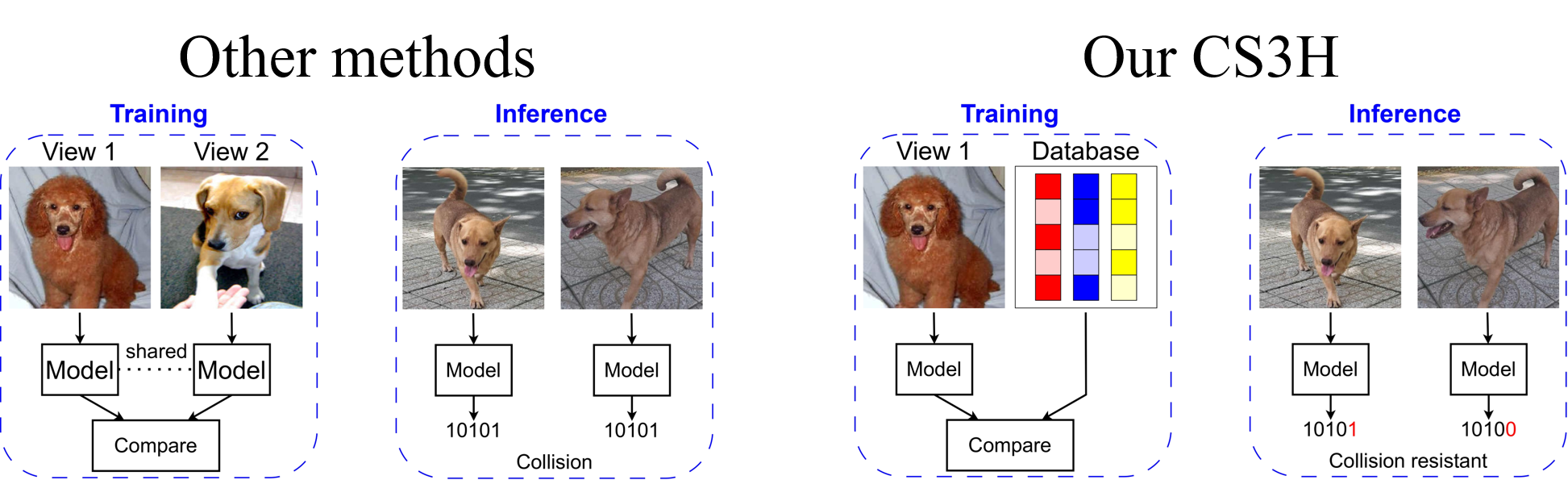
Framework
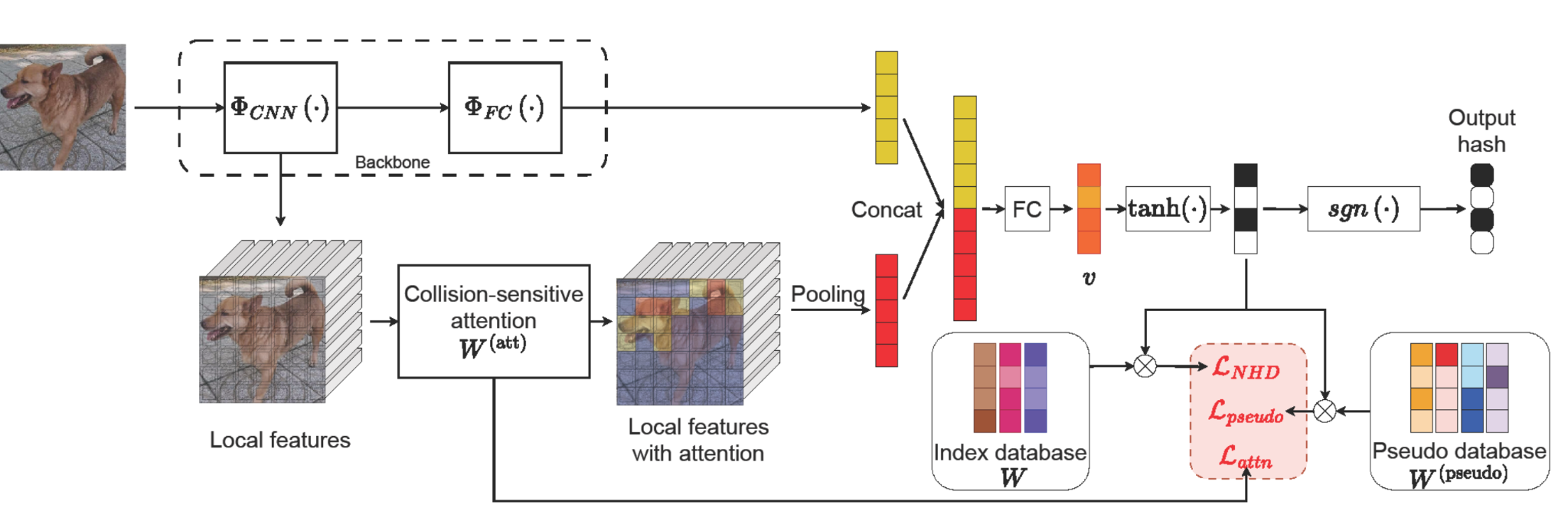
Experiments
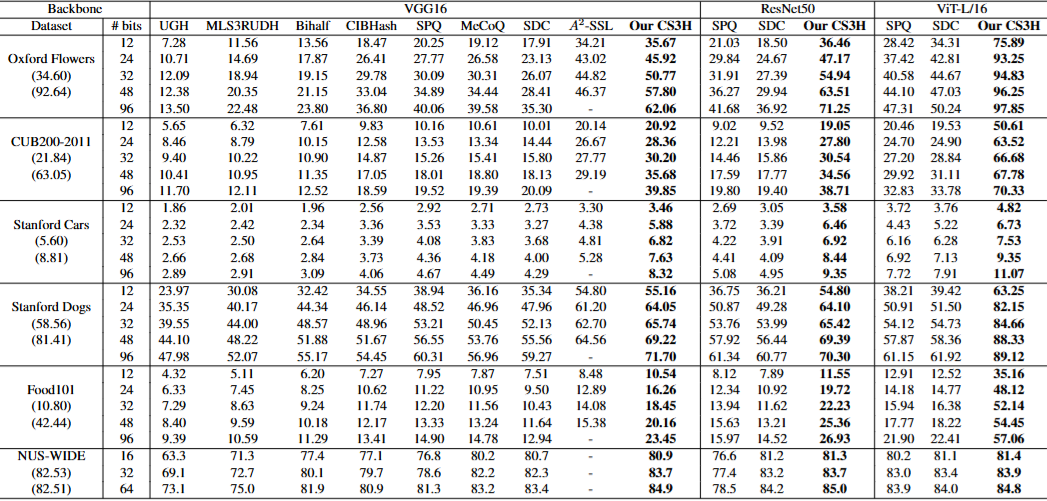
Retrieval
Retrieval mAP (%) comparison under the unsupervised learning scenario. The number below each dataset is the retrieval performance of continuous features of pretrained VGG-16 and ViT-L/16 with dimensions 4096 and 1024, respectively using cosine similarity
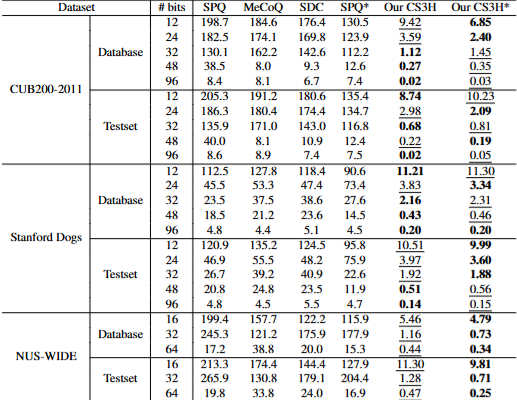
Collision rate (‱)
Collision probability (‱). * denotes the hard-unsupervised.
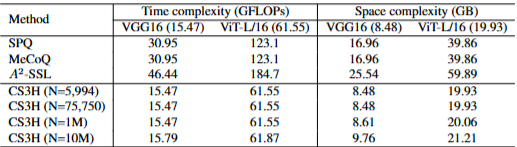
Complexity
Complexity across dataset sizes (N images). Numbers in parentheses indicate the complexity of the backbone itself.
Qualitative
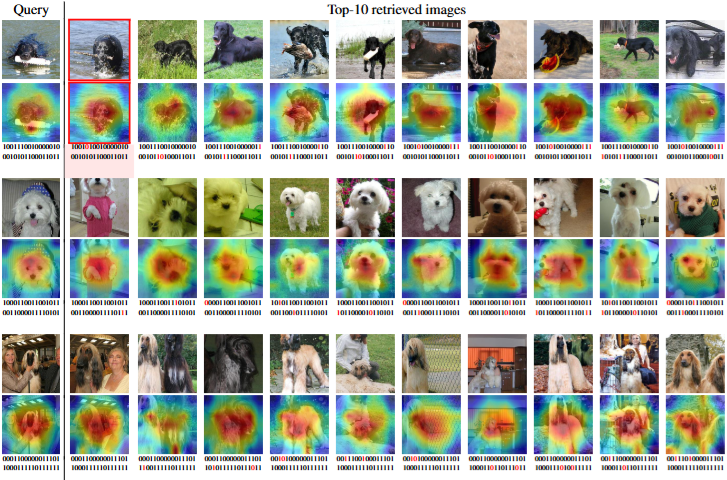
Qualitative retrieval examples with 32-bit hash codes of CS3H with VGG16 backbone on Stanford Dogs dataset.
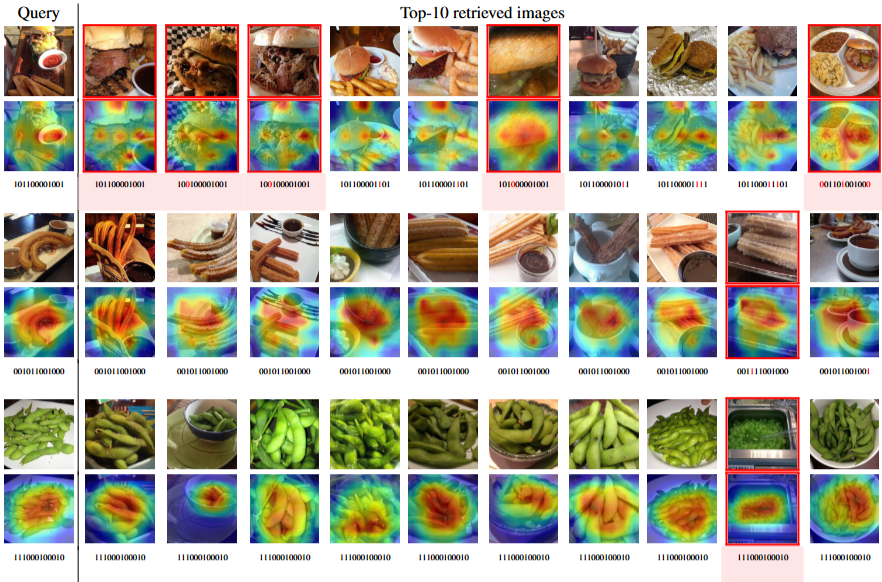
Qualitative retrieval examples with 12-bit hash codes of CS3H with ResNet backbone on Food-101 dataset
Acknowledgements
This work was supported by the ANR project ExcelLR (ANR-21-EXES0010) and the L3i Laboratory computing resources.
Citation
@inproceedings{duong2026collision,
author={Duong, Anh-Kiet and Gomez-Krämer, Petra and Carozza, Jean-Michel},
booktitle={2026 IEEE International Conference on Image Processing (ICIP)},
title={Collision-Resistant Single-Pass Method for Unsupervised Fine-Grained Image Hashing},
year={2026},
pages={1-6},
doi={10.1109/ICIP61757.2026.11630517}
}